






















If rising costs are squeezing your cash flow, a Paused Payments Mortgage can give you breathing room. You unlock a portion of your home equity, make no monthly payments during the term, and repay when you sell, refinance, or pay out early. It’s built for Canadians who need time and flexibility without losing ownership.

Access Equity Now. Pause Payments. Keep Control.
How a Paused Payments Mortgage works
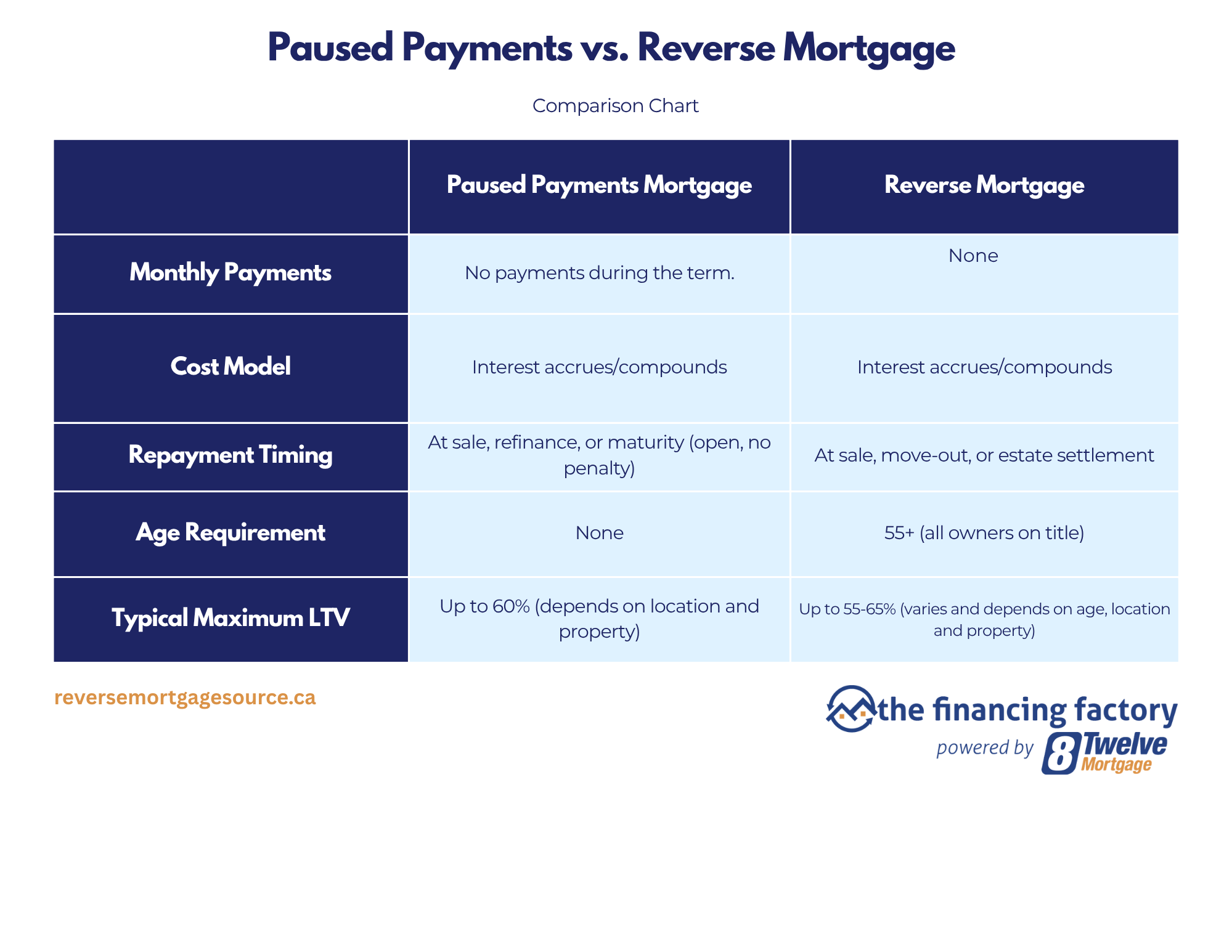
You borrow up to 60% of the appraised value of your home in eligible cases. There are no monthly payments for up to five years. Interest accrues and compounds during the term and is settled when you exit or at maturity. There are no prepayment penalties, so you can repay early if life changes. Available to homeowners of any age in Ontario, British Columbia, and Alberta (subject to approval and property criteria).
Who Benefits from Pausing their mortgage payments
- Homeowners who need short-to-medium-term relief from payments
- People planning to refinance, downsize, or sell within a few years
- Owners who want to consolidate higher-interest debt or fund key goals (repairs, accessibility, family support) without taking on a monthly obligation
Key advantages
- No monthly payments during the term, easing cash flow
- Open term – pay out anytime with no prepayment penalties
- No age restriction; approval focuses on property and equity
- Up to 60% LTV in eligible scenarios, subject to appraisal and location
Important considerations
- Interest adds to your balance while payments are paused. Plan your exit (refinance, sale, or payout) before maturity.
- You must keep property taxes, insurance, and maintenance up to date.
- This is not a short-term “payment deferral”; it’s a mortgage designed with no payments for the term and a scheduled settlement at or before maturity.
What you can use the funds for?
Cover rising costs, clear higher-interest debt, complete essential home updates, support family, or bridge to your next move; all without adding a monthly payment during the term.
FAQ's About Paused Payments Mortgage
Is a Paused Payments Mortgage just delaying the problem?
Not necessarily. It depends on why you're using it. If pausing your mortgage payments simply allows debt to continue growing without a plan, it probably isn't the right solution. However, if the goal is to create breathing room while you improve your financial situation, it can become a valuable planning tool. Many homeowners use the extra cash flow to eliminate higher-interest debt, recover from a temporary loss of income, complete renovations that increase the value of their home, stabilize a business, or bridge the gap until retirement, a property sale, or another financial milestone. Like any mortgage, success isn't determined by the product itself—it's determined by having a clear strategy for what happens next. That's why we spend time understanding your goals before recommending whether this solution makes sense for your situation.
If there are no monthly mortgage payments, how does the lender get paid?
Instead of making monthly principal and interest payments, the interest is added to your mortgage balance throughout the term. This means your mortgage balance grows over time and is repaid when you refinance, sell your home, or the mortgage term comes to an end. For many homeowners, this trade-off is worthwhile because it immediately improves monthly cash flow during a period when money is tight. Before moving forward, you'll receive illustrations showing how the balance may grow over the term so you can make an informed decision. A Paused Payments Mortgage isn't about making your mortgage disappear. It's about replacing today's monthly payment obligation with a repayment strategy that better fits your current circumstances.
Does choosing a Paused Payments Mortgage mean I'm in financial trouble?
Absolutely not. Many Canadians using this type of mortgage have never missed a mortgage payment. They're simply responding to changing financial realities. Some are self-employed and experience fluctuating income. Others are navigating a career change, temporary layoff, parental leave, divorce, retirement, or rising living costs. Some simply prefer to preserve their savings rather than use every dollar to make mortgage payments during a challenging period. Financial planning isn't just about paying down debt as quickly as possible. Sometimes it's about improving cash flow, protecting your savings, and giving yourself flexibility until circumstances improve. Choosing a different mortgage strategy doesn't mean you've failed. It means you're exploring options before financial pressure becomes a crisis.
Could pausing my mortgage payments actually improve my financial position?
It can—if it's used strategically. Many homeowners focus only on the interest they'll pay while overlooking the opportunities created by stronger monthly cash flow. For example, the money that would have gone toward mortgage payments could be used to eliminate higher-interest debt, avoid borrowing on credit cards, keep a business operating during a slower period, complete renovations, or build an emergency fund. The right question isn't simply, "How much interest will I pay?" It's also, "What is the cost of not having access to that cash today?" Every homeowner's situation is different, which is why it's important to compare both the costs and the potential financial benefits before making a decision.
How do I know if a Paused Payments Mortgage is the right option instead of refinancing, a second mortgage, or a reverse mortgage?
The best mortgage is the one that solves your specific problem—not necessarily the one with the lowest interest rate. A conventional refinance may be the better choice if you have strong income and qualify for lower rates. A reverse mortgage may be appropriate for homeowners aged 55 and older who are looking for a longer-term solution. A second mortgage may work if you can comfortably manage an additional monthly payment. A Paused Payments Mortgage is often considered when the priority is improving monthly cash flow without taking on another payment obligation. It offers flexibility that many traditional mortgage products simply don't provide. That's why the first conversation shouldn't be about choosing a product. It should be about understanding your goals, your timeline, and your exit strategy. Once those are clear, it becomes much easier to determine which mortgage solution is the best fit.
Get advice you can trust
The Reverse Mortgage Source is Canada’s number one Reverse Mortgage and home equity solutions learning portal. When you’re ready, mortgage solutions are powered by The Financing Factory. We’ll review your equity, location, property type, and exit strategy and give you straight answers in plain language.