An older couple dances barefoot in a bright, modern living room with large windows overlooking a lush garden—perhaps discussing equity release eligibility requirements as they enjoy their cosy, contemporary space.

This guide explains how reverse mortgages work in Canada, who qualifies, how much you may be able to borrow, what the costs are, and how a reverse mortgage compares to other ways of accessing home equity.

Reverse Mortgages in Canada: The Complete Guide for Homeowners 55+

If you are a Canadian homeowner 55 or older, your home may hold more value than any other asset you own. The challenge is that home equity does not help much with monthly expenses unless you can access it in a way that fits your life.

That is where a reverse mortgage may be worth understanding.

A reverse mortgage in Canada lets eligible homeowners access part of their home equity as tax-free cash. You do not have to sell your home. You do not have to make regular monthly mortgage payments. The loan is repaid later, usually when the home is sold, when you permanently move out, or when the last borrower passes away.

This guide explains how reverse mortgages work in Canada, who qualifies, how much you may be able to borrow, what the costs are, and how a reverse mortgage compares to other ways of accessing home equity.

What Is a Reverse Mortgage in Canada?

A reverse mortgage is a mortgage loan secured against your home. It is available to Canadian homeowners, usually 55 or older. The purpose is simple: it lets you convert part of your home equity into cash while you continue living in your home.

With a regular mortgage, you make payments every month, and the balance goes down over time. With a reverse mortgage, you are not required to make monthly payments. The interest is added to the loan balance, so the amount owing grows over time.

The money you receive from a reverse mortgage is loan proceeds. That means it is generally not treated as taxable income. You can usually use the funds however you choose. Some homeowners use the money to pay off an existing mortgage or line of credit. Others use it to cover retirement income gaps, renovate, support in-home care, help family, or keep more savings invested.

The part that often confuses people, and is a common myth about reverse mortgages, concerns homeownership: a reverse mortgage does not mean you give up your home. You remain on title. You continue to own and enjoy the property. The lender simply registers a mortgage against the home, just as they would with a regular mortgage or home equity line of credit.

How Does the Interest Work on a Reverse Mortgage?

Interest on a reverse mortgage is added to the loan balance. Because you are not making required monthly payments, the balance grows over time. This is sometimes called a rising-debt mortgage. The term sounds technical, but the idea is straightforward: the debt rises because the interest is being added instead of paid each month.

For example, if you borrowed $100,000 at 7% and made no payments for one year, the balance would be roughly $107,000 before considering fees and the exact compounding method. Over a longer period, the effect becomes more noticeable because interest is charged on a growing balance.

That is the main trade-off. You get access to cash now without taking on a monthly payment. In exchange, your home equity is reduced over time. A clear reverse mortgage conversation should always show you what the balance may look like later, not only what you can access today.

Who Offers Reverse Mortgages in Canada?

Reverse mortgages in Canada are offered by various federally regulated financial institutions and arranged by licensed mortgage professionals. What should matter most to the homeowner is understanding that the product is regulated, that the mortgage is registered against the home, and that the terms must be reviewed carefully before signing.

The Financing Factory can help you compare available reverse mortgage options without requiring you to figure out the lender landscape on your own. The role of a broker is to translate the terms, explain the differences, and help you understand whether the structure fits your goals.

How Do Reverse Mortgages Work, Step by Step?

A reverse mortgage has more steps than a regular online loan application, but the process is manageable when you know what happens in order. The lender needs to confirm your age, property value, ownership, location, and existing debts secured against the home.

Here is the typical process.

  1. Initial review
    You speak with a licensed mortgage professional about your age, property, estimated home value, and current mortgage or line of credit balance. This helps estimate how much home equity may be available.
  2. Application
    Basic information is collected about the homeowners on title, the property, and any mortgages, liens, or secured debts that must be paid out.
  3. Home appraisal
    An independent appraisal confirms the current market value of the property. This matters because the lending amount is based partly on the home’s appraised value.
  4. Approval and terms
    The lender confirms the amount available, interest rate, fees, payout structure, and any conditions that must be satisfied before funding.
  5. Legal review and funding
    You receive independent legal advice before closing. Once the documents are signed and registered, the funds are advanced based on the structure you selected.
builtit-image

Some homeowners receive one lump sum. Others choose scheduled advances. In some cases, a combination can be used. The best structure depends on what you are trying to solve. Paying off a mortgage may require a lump sum. Supplementing monthly retirement income may call for a different setup.

The process usually takes several weeks because of the appraisal, approval, and legal steps. That time is useful. It gives you space to understand the numbers and ask questions before making a decision.

Not Quite Ready to Call?

Taking your time to learn by gathering information, that is a reasonable place to start. Reverse mortgages have moving parts, and a good decision needs more than a quick rate quote. The Financing Factory can walk you through the basics, explain the terms in plain language, and help you understand what questions to ask before you proceed.

How Does a Reverse Mortgage Get Repaid?

A reverse mortgage is usually repaid when the home is sold, when the homeowner permanently moves out, or when the last borrower passes away. The repayment comes from the sale proceeds or from other funds if the homeowner or estate chooses to keep the property.

If the home is sold, the reverse mortgage balance is paid first. Any remaining equity goes to the homeowner or the estate. This is an important point because a reverse mortgage does reduce home equity over time, but it does not automatically use up all the home’s equity.

For adult children and estate planning, the timeline should be discussed early. The estate usually has a defined period to repay the mortgage after the last borrower passes away. The exact timeline depends on the mortgage agreement, so the family should understand the terms before signing.

What Happens to My Home with a Reverse Mortgage?

You stay on title and keep full ownership.

This is one of the most common concerns. A reverse mortgage does not transfer ownership to the lender. You still own the property. You can continue living in the home as long as you meet the ongoing obligations in your mortgage agreement.

Those obligations usually include paying property taxes, keeping home insurance in place, maintaining the property, and using the home as your primary residence. If those responsibilities are not met, the lender may have the right to call the loan. This is why the decision should be made with a full view of your budget, not only the amount you can borrow.

The practical way to think about it is this: your home remains your home, and the reverse mortgage is a loan registered against it.

Do I Qualify for a Reverse Mortgage in Canada?

Reverse mortgage eligibility in Canada is based mainly on age, home ownership, property type, property value, and location. The starting point is usually age 55. If there is more than one owner on title, each owner typically needs to meet the minimum age requirement.

The lender will also look at the home itself. The property must meet lending guidelines and have enough value to support the requested amount. Urban and suburban properties are often easier to assess. Rural or remote properties may need a closer review because resale market, location, and property type can affect lending limits.

A reverse mortgage does not work like a standard refinance. Traditional mortgage approvals rely heavily on income, credit score, and monthly payment affordability. A reverse mortgage is primarily based on your age and the value of your home. Credit and income may still be reviewed, but they are not assessed in the same way as a regular mortgage where monthly payments are required.

Common eligibility factors include:

  • You are 55 or older.
  • All owners on title meet the age requirement.
  • You own a home in Canada.
  • The property is your primary residence.
  • The home meets property and location guidelines.
  • Existing secured debts can be paid out from the reverse mortgage proceeds if required.

This is the part that many homeowners find relieving. If your retirement income is modest, that does not automatically remove the option. The application is built around home equity, not employment income.

Minimum Age for a Reverse Mortgage in Canada

The minimum age for a reverse mortgage in Canada is generally 55. If a couple owns the home together, both spouses or co-owners on title usually need to be at least 55.

When one spouse is under 55, the situation needs careful review. Removing someone from title may create legal, estate, tax, or family law issues. That decision should never be treated as a quick paperwork change. It should be reviewed with proper legal advice before moving forward.

Can I Get a Reverse Mortgage on a Condo?

Yes, many condos can qualify for a reverse mortgage in Canada. The condo must usually be owner-occupied and meet the lender’s property guidelines. The lender may review the building, condo corporation, location, marketability, and overall condition.

The building matters because the lender is relying on the property as security. A well-managed condo in an established area is usually easier to assess than a building with major structural concerns, limited resale activity, or unclear financial health.

Detached homes, townhomes, and some condos may qualify. Co-operative housing, some leasehold properties, unique rural homes, or properties with limited resale demand may need a deeper review. The simplest next step is to confirm property eligibility before spending time on a full application.

How Many Days Do I Need to Live in My Home?

With a reverse mortgage in Canada, the home usually needs to remain your principal residence. In plain language, that means it must be the home you live in for most of the year and the address you treat as your main home.

Some Canadian reverse mortgage providers define this as living in the home for at least 6 months of the year. This is often explained as about 183 days in a calendar year. The reason this matters is that reverse mortgages are meant for primary residences, not cottages, rental properties, or investment properties.

This does not mean you can never travel. Snowbird trips, family visits, vacations, and temporary medical stays may be acceptable if the home remains your main residence and you intend to return. The details matter. If you expect to be away for an extended period, it is better to ask before you leave so you understand what your mortgage agreement allows.

If you permanently move out, sell the home, or move into long-term care with no intention of returning, the reverse mortgage may become due. At that point, the loan usually needs to be repaid through a sale, refinance, or other funds. If there is more than one borrower and one spouse still lives in the home as their principal residence, the mortgage may remain in good standing, depending on the terms.

The practical step is simple: before an extended absence, confirm the occupancy rules in your mortgage agreement. Keep the home insured, maintain the property, pay property taxes, and make sure the lender can reach you or your appointed representative if needed.

How Much Can I Borrow With a Reverse Mortgage?

builtit-image

The amount you can borrow with a reverse mortgage depends on your age, home value, property type, location, and any existing debt secured against the home. In Canada, some homeowners may be able to access up to 55% of the home’s appraised value. Many borrowers access less than the maximum.

This is where estimates can be useful, but they are not final approvals. A calculator can give you a starting point. The actual number is confirmed after the lender reviews the property and receives the appraisal.

If you already have a mortgage, home equity line of credit, or other secured debt against the property, those debts usually need to be paid out first from the reverse mortgage proceeds. The amount left after those payouts is the net cash available to you.

For example, if your home is valued at $900,000 and your reverse mortgage approval is $300,000, but you still owe $80,000 on a HELOC, that HELOC would usually be paid out first. The remaining funds would then be available for your use.

What Factors Affect Your Borrowing Limit?

Several factors shape your reverse mortgage borrowing limit.

  • Age
    Older borrowers may qualify for a higher percentage of the home’s value because the expected loan period is shorter.
  • Appraised home value
    The lender uses an independent appraisal to confirm the property’s market value.
  • Location
    Properties in strong, established markets may qualify for higher lending amounts than properties in remote or harder-to-sell areas.
  • Property type
    Detached homes in active resale markets are often easier to lend against. Condos and rural properties may still qualify, but details matter.
  • Existing secured debt
    Any mortgage, HELOC, or registered secured loan must be considered. These debts reduce the net amount available.
  • Chosen payout structure
    Taking all funds upfront may create a different long-term balance than drawing funds over time.

The borrowing limit is not only about what the lender allows. It is also about what makes sense for your life. A strong review should show both the maximum available and the amount that actually fits your goals.

Reverse Mortgage Calculator: Estimate Your Amount

A reverse mortgage calculator can help you estimate how much home equity you may be able to access. The calculator usually uses your age, estimated home value, province, property type, and existing mortgage balance to produce a rough estimate.

Use the calculator as a starting point, not a final answer. The confirmed amount depends on an appraisal and lender review. Still, it can help you see whether the numbers are worth exploring before you speak with anyone.

The Key Benefits of a Reverse Mortgage in Canada

A reverse mortgage can help when most of your wealth is tied up in your home, and your monthly income does not stretch as far as it used to. The benefit is not only access to cash. It is access to cash without adding a required monthly payment.

For many retired homeowners, that payment structure is the reason the product is considered. A HELOC or refinance may offer access to equity, but both usually require income qualification and ongoing payments. A reverse mortgage works differently because repayment is deferred.

No Monthly Payments

With a reverse mortgage, you are not required to make regular monthly payments toward principal or interest. The interest is added to the balance, and repayment happens later.

This can make a meaningful difference for a homeowner living on pension income, CPP, OAS, investments, or savings. Removing a mortgage payment, line of credit payment, or high-interest debt payment can create more room in the monthly budget.

Voluntary payments may be allowed, depending on the mortgage terms. Some homeowners choose to pay interest occasionally or make partial payments to slow the growth of the balance and preserve more home equity.

Tax-Free Cash That Does Not Affect Your Benefits

Reverse mortgage funds are generally treated as loan proceeds, not employment income or taxable earnings. That means the funds are generally received tax-free.

This is important for Canadian retirees who receive Old Age Security or the Guaranteed Income Supplement. Because the funds are loan proceeds, they generally do not count as income for those federal benefits. If you receive income-tested provincial benefits or have a more complex tax situation, speak with a tax adviser before making a final decision.

The practical point is simple: the cash can help your monthly life without creating the same tax treatment as withdrawing from some investments or earning additional taxable income.

The “No-Negative-Equity” Protection

Reverse mortgages in Canada commonly include a protection that ensures the amount owing does not exceed the home’s fair market value when it is sold, as long as the mortgage obligations are met.

This helps address a major fear: leaving family with a mortgage debt larger than the property value. If the home is sold and the mortgage is repaid, any remaining equity belongs to the homeowner or estate.

This protection does not mean the loan is free of risk or cost. It means the repayment is tied to the home’s value, and the estate is not expected to repay more than the home is worth under the terms of the guarantee.

Reverse Mortgage vs. HELOC and Other Alternatives

A reverse mortgage is one way to access home equity. It should be compared against other options, including a HELOC, traditional refinance, downsizing, using savings, family support, or selling another asset.

The right option depends on your income, credit profile, age, home value, monthly budget, estate goals, and how long you plan to stay in the home.

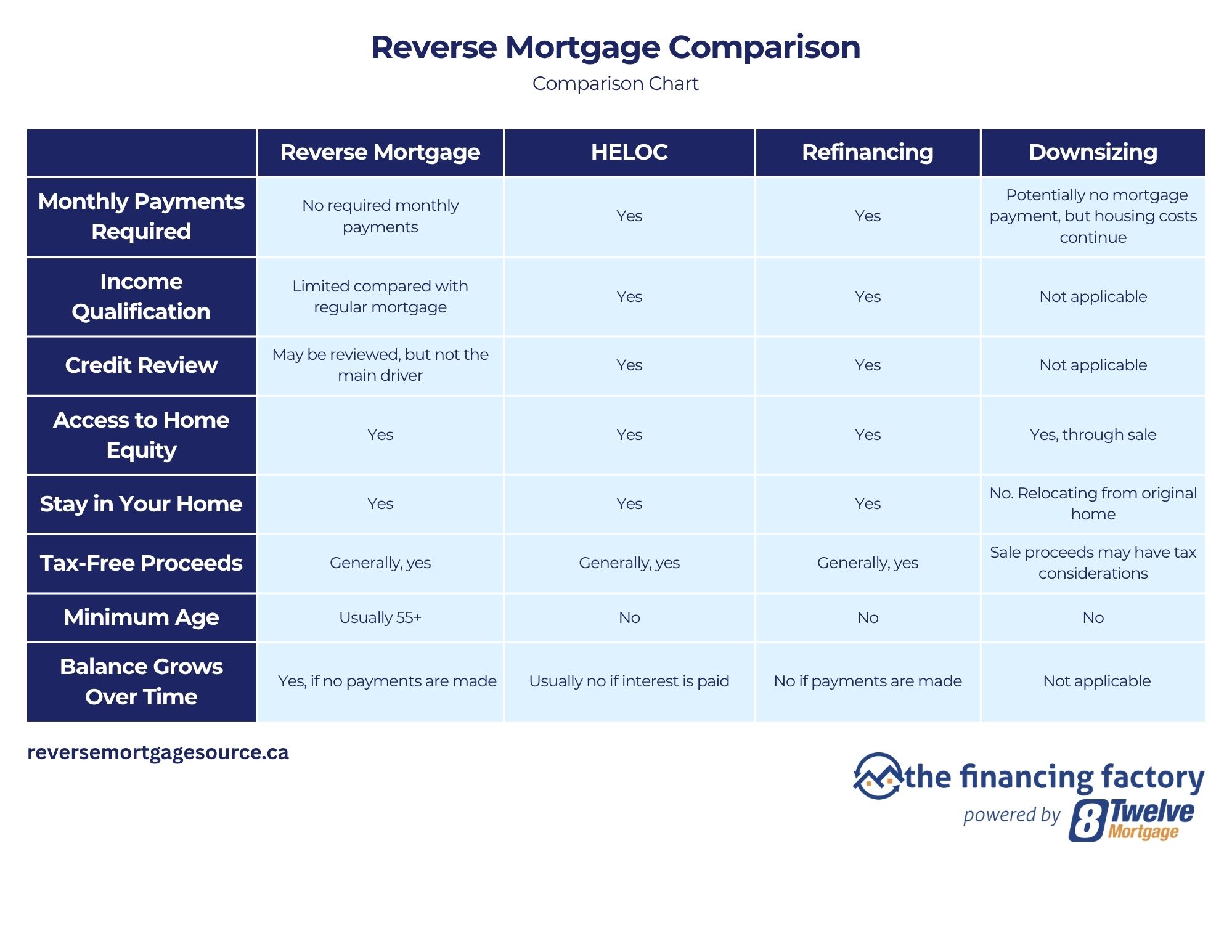
A comparison chart highlights Reverse Mortgages, HELOC, Remortgaging, and Downsizing in Canada, detailing payments, qualifications, credit checks, accessibility, proceeds, age, balance—and reverse mortgage eligibility requirements.

Reverse Mortgage vs. HELOC

A HELOC is a home equity line of credit. It lets you borrow against your home, usually with interest-only payments required each month. For homeowners with strong income, solid credit, and comfort with variable rates, a HELOC can be useful.

The challenge is qualification. Many retired Canadians have strong home equity but lower taxable income. A lender may still decline a HELOC if the monthly payment does not fit its income rules. The payment may also rise if interest rates increase.

A reverse mortgage may be easier to consider when the main issue is cash flow. There are no required monthly payments, and the approval is based more heavily on age, property value, and available home equity.

Reverse Mortgage vs. Refinancing

Refinancing means replacing or increasing your existing mortgage to access more funds. It can provide a larger amount than a reverse mortgage in some cases, especially if you qualify under standard mortgage rules.

The key issue is payment affordability. A refinance requires income qualification, credit review, and regular mortgage payments. If your retirement income does not support the payment under lender guidelines, refinancing may not be available even when the home has significant equity.

For homeowners who qualify comfortably and want to keep paying down debt, refinancing may work well. For homeowners who need access to equity without a new monthly payment, a reverse mortgage may be worth reviewing.

Reverse Mortgage vs. Downsizing or Selling

Downsizing can release a large amount of equity. It may also reduce maintenance, property taxes, and household responsibilities. For some homeowners, it is the right move.

The financial side deserves a full review. Selling comes with real estate commissions, moving costs, legal fees, possible land transfer tax on the next purchase, and the cost of setting up a new home. Renting after selling may also create long-term cost pressure, especially in high-rent markets.

The personal side matters too. A home is not only an asset. It may be close to family, doctors, neighbours, transit, faith communities, and familiar routines. A reverse mortgage may help some homeowners stay in place longer while still accessing part of the equity they built.

What Are the Cons of a Reverse Mortgage in Canada?

A reverse mortgage is not suitable for every homeowner. The main concern is cost over time. Because payments are not required, the interest is added to the balance. The longer the loan remains in place, the more the balance can grow.

This does not make the product wrong. It means the homeowner needs to understand the trade-off clearly. A reverse mortgage can improve cash flow today, but it usually reduces the equity available later.

Other costs also matter. Appraisal fees, legal fees, setup fees, discharge fees, and early repayment charges may apply depending on the product and timing. These should be reviewed before signing.

Interest Accumulates Over Time

The interest on a reverse mortgage compounds. This means interest is charged on the original amount borrowed and on interest that has already been added to the balance.

For example, if a homeowner borrows $200,000 at 7% and makes no payments for 10 years, the balance can grow significantly. The exact amount depends on the rate, compounding method, fees, and payout structure.

This matters most when preserving maximum estate value is the top priority. If the goal is to leave as much home equity as possible to heirs, the family may want to compare other options or consider making voluntary payments if the mortgage terms allow.

Setup Costs and Fees

Reverse mortgages can include several upfront and closing costs. These may include:

  • Home appraisal fee
  • Independent legal advice
  • Lender administration or setup fee
  • Title or registration-related costs
  • Discharge or early repayment charges in some situations

Some fees may be deducted from the mortgage proceeds instead of being paid out of pocket. That can make closing easier, but the costs still matter because they reduce the net amount available or increase the amount owing.

The right way to assess fees is to look at the full picture. A one-time fee may be reasonable if the homeowner plans to keep the reverse mortgage for several years and the cash-flow benefit is meaningful. It may be less suitable for someone planning to sell in the near future.

Who Should Consider a Reverse Mortgage?

A reverse mortgage may be worth considering if you are a Canadian homeowner 55 or older, have meaningful home equity, and want to stay in your home while accessing cash.

It may be useful if you want to:

  • Pay off an existing mortgage or HELOC.
  • Reduce high-interest debt.
  • Supplement retirement income.
  • Renovate or make the home safer for aging in place.
  • Pay for in-home care or health-related costs.
  • Help adult children or grandchildren.
  • Avoid selling investments during an unfavourable time.
  • Create a cash reserve for rising living costs.

The decision should connect to a plan. A reverse mortgage works best when you know what the funds are for, how long you expect to stay in the home, and how the loan may affect future equity.

Is a Reverse Mortgage Conversation Open to Adult Children as Well?

Adult children are often part of the reverse mortgage conversation. Sometimes they are the ones doing the research. They may be worried about a parent’s cash flow, safety at home, debt, or ability to afford care.

Their concerns are reasonable. A reverse mortgage can reduce the equity left in the estate, so inheritance should be discussed openly. At the same time, home equity can also support a parent’s quality of life now. Helping a parent stay safely in their home can be part of protecting the family, especially when the alternative is financial stress, deferred repairs, or a rushed sale.

Some families also use reverse mortgage funds for an early inheritance. A parent may choose to gift money to an adult child for a home purchase, debt repayment, or family support. That kind of decision should be reviewed with legal and tax professionals, so everyone understands the implications.

builtit-image

Frequently Asked Questions About Reverse Mortgages in Canada

What is a reverse mortgage in Canada?

A reverse mortgage is a loan secured against your home that allows eligible homeowners, usually age 55 or older, to access part of their home equity as cash. You continue to own and live in your home, and you are not required to make regular monthly mortgage payments. The balance is repaid later, usually when the home is sold, when you permanently move out, or when the last borrower passes away.

Do I still own my home with a reverse mortgage?

Yes. You remain the owner of your home and stay on title. The reverse mortgage is registered against the property as a loan. You are still responsible for property taxes, insurance, and maintenance. Those responsibilities matter because the home is the security for the mortgage.

How much can I borrow with a reverse mortgage?

The amount depends on your age, home value, property type, location, and any existing mortgage or HELOC balance. Some Canadian homeowners may qualify for up to 55% of the appraised value, although many borrowers access less than the maximum. The fastest way to get a realistic estimate is to speak with The Financing Factory. A short review can help estimate your amount before a full application.

Does a reverse mortgage affect OAS or GIS?

Reverse mortgage funds are generally loan proceeds, not taxable income. Because of that, they generally do not affect Old Age Security or the Guaranteed Income Supplement. If you receive other income-tested benefits or have a more complex tax situation, speak with a tax professional before moving forward.

Can I get a reverse mortgage if I still have a mortgage?

Yes, but the existing mortgage must be paid out from the reverse mortgage proceeds first. The same often applies to a HELOC or other registered secured debt. After those debts are paid, any remaining funds are available for your use.

Can I make payments on a reverse mortgage?

Some reverse mortgage products allow voluntary payments. This may include interest payments, partial payments, or larger prepayments within the terms of the mortgage. Making voluntary payments can slow the growth of the balance and help preserve more equity. The exact rules should be reviewed before signing.

How many days do I need to live in my home with a reverse mortgage in Canada?

Your home usually needs to remain your principal residence. Some Canadian reverse mortgage providers define this as living in the home for at least 6 months of the year, or about 183 days. Travel, snowbird stays, and temporary medical absences may be acceptable if the home remains your main residence and you intend to return. If you permanently move out, sell the home, or enter long-term care with no plan to return, the reverse mortgage may become due.

What happens when I pass away?

When the last borrower passes away, the reverse mortgage becomes repayable. The estate can usually repay the loan by selling the property, refinancing, or using other funds. If the home is sold, the mortgage balance is paid first. Any remaining equity goes to the estate.

Can I use the reverse mortgage proceeds to help my family?

Yes. Many homeowners use reverse mortgage funds to help adult children or grandchildren. This could include help with a home purchase, education, debt repayment, or family support. This should be handled carefully. A gift can affect family expectations, estate planning, and long-term financial security. Legal and tax advice can help you make the decision clearly.

Is a reverse mortgage a good idea if I plan to sell soon?

If you plan to sell within the next year or two, a reverse mortgage may be less suitable because setup costs and potential repayment charges can make it expensive for a short hold but there are short and open terms available at a higher interest rate. A reverse mortgage tends to make more sense when you plan to stay in the home for several years and need the funds to support a clear goal.

What is the main risk of a reverse mortgage?

The main risk is that the loan balance grows over time and reduces your remaining home equity. This can affect your estate, future downsizing plans, or the amount available for long-term care later. That risk can be managed by borrowing only what you need, understanding the cost over time, and reviewing voluntary payment options if available.


Ready to Find Out How Much You Could Access?

By now, you have a working understanding of how reverse mortgages work in Canada. You know what the product does, how repayment works, what affects qualification, and why the balance grows over time. The next step is to look at your actual numbers. Your age, property value, location, existing mortgage balance, and goals will shape what is possible. There is no cost to speak with The Financing Factory. No commitment. No paperwork on the first call. Just a clear conversation about whether a reverse mortgage makes sense for you and how much home equity you may be able to access.

A green outline of two house rooftops with square windows, surrounded by a circular arrow, on a blue background. Perfect for android or chrome use; optimised at 512x512 resolution.

The Reverse Mortgage Source Editorial Team is dedicated to generating education content for Reverse Mortgage Source an educational portal helping homeowners understand reverse mortgages and home equity options in Canada.